
Caravel Historic Sail Training Ship ‘Vera Cruz’ Spars 2008
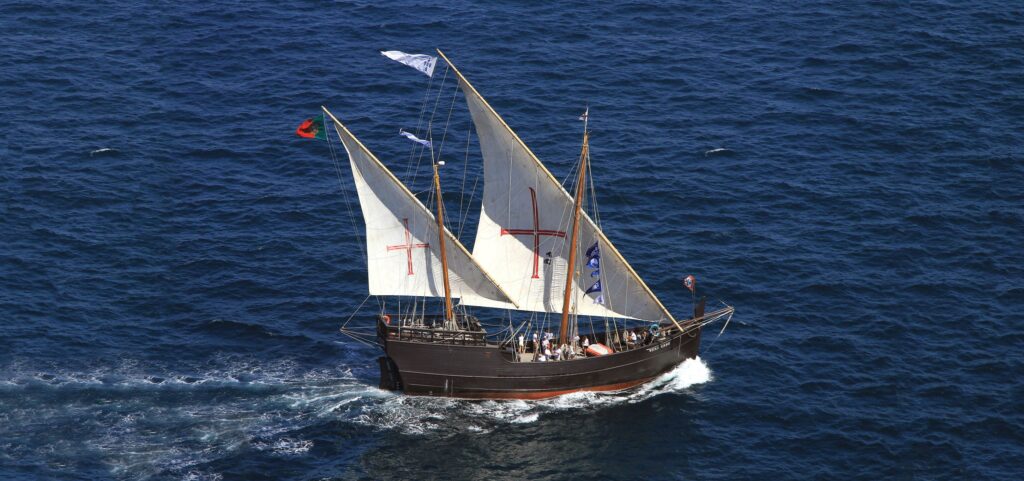
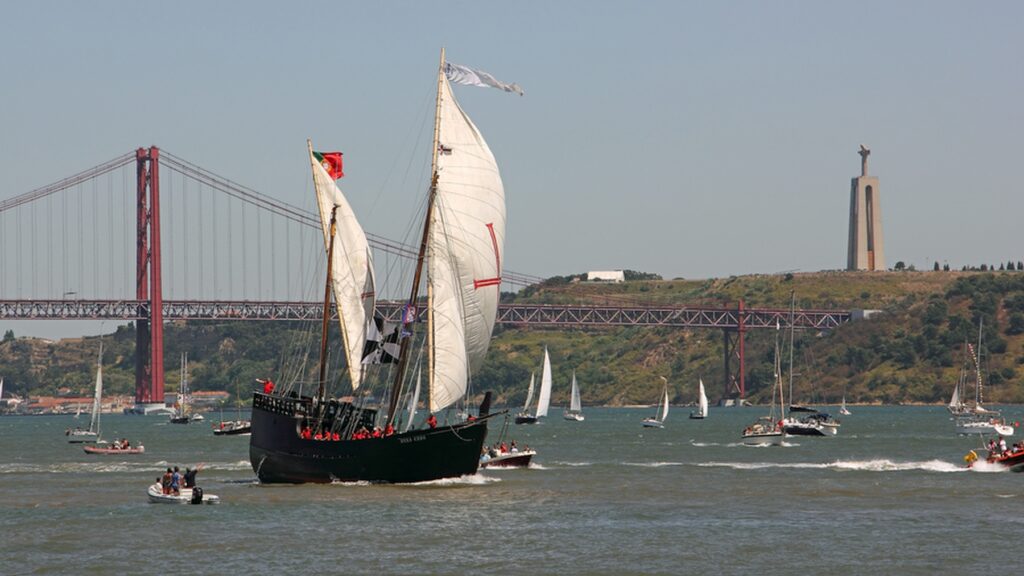
A caravel (Portuguese: ‘caravela’) is a small, highly manoeuvrable sailing ship developed in the 15th century by the Portuguese to explore along the West African coast and into the Atlantic Ocean. The lateen sails gave it speed and the capacity for sailing into the wind (beating). Caravels were used by the Portuguese for the oceanic exploration voyages during the 15th and 16th centuries in the Age of Discovery. Prince Henry the Navigator, Christopher Columbus, Bartolomeu Dias and Vasco de Gama all used caravels.
The replica Portuguese Caravel ‘Vera Cruz’ is owned by the charitable trust ‘APORVELA’ in Lisbon, which aims introduce school children and adults to sailing and the rich Portuguese maritime history. However, her two original 27m eucalyptus lateen yard spars were both too heavy for young people to haul up the mast and also had a extremely limited life due to rot (see photo below).
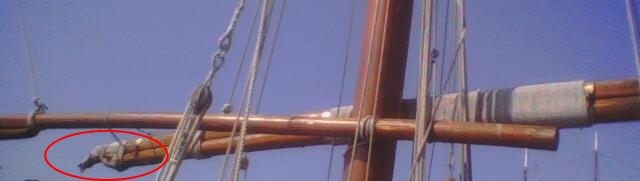
Hence, my colleague Dr. Nuno Fonseca and myself (with valuable advice from Paul Miller) designed new custom carbon fibre spars, at no cost. This included laminate material property and scale replica testing.
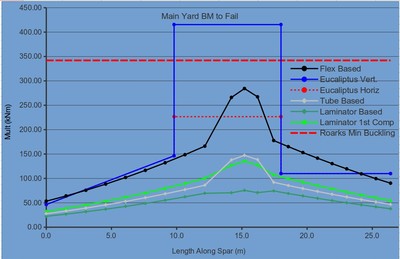
The main design problems were that loading and geometry were both non-standard and variable (the yard is in bending around the mast, and is free to move in all three directions), and that there was no available data for lateen sail rig loads.
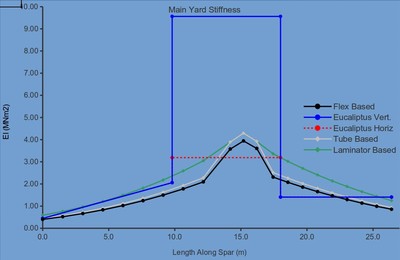
Hence, the design process ensured that the carbon beams were as stiff as the original eucalyptus spars (tweaking the tip geometry to give a little more twist off in the gusts), whilst ensuring no significant loss in strength. Checks were also made against data from similar sails, and scale model tests provided an extra verification.
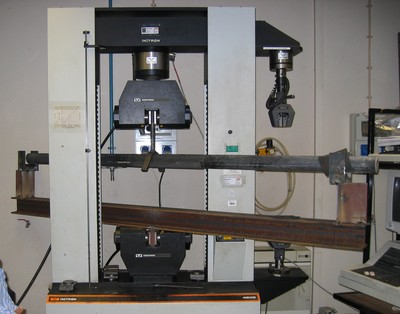
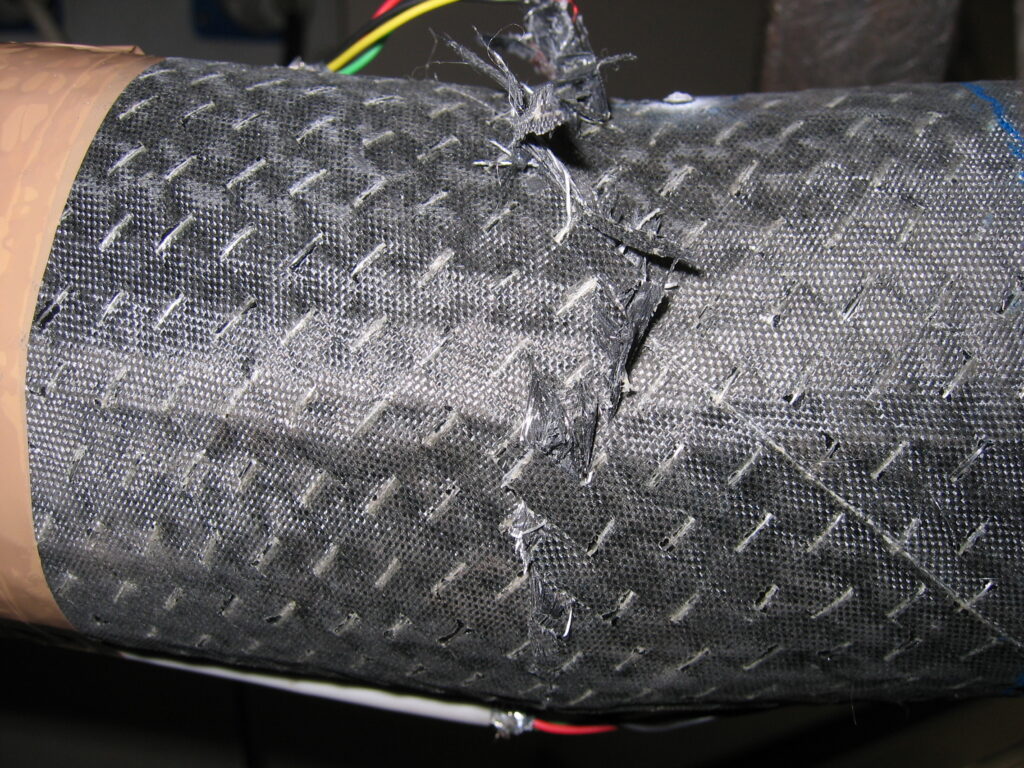
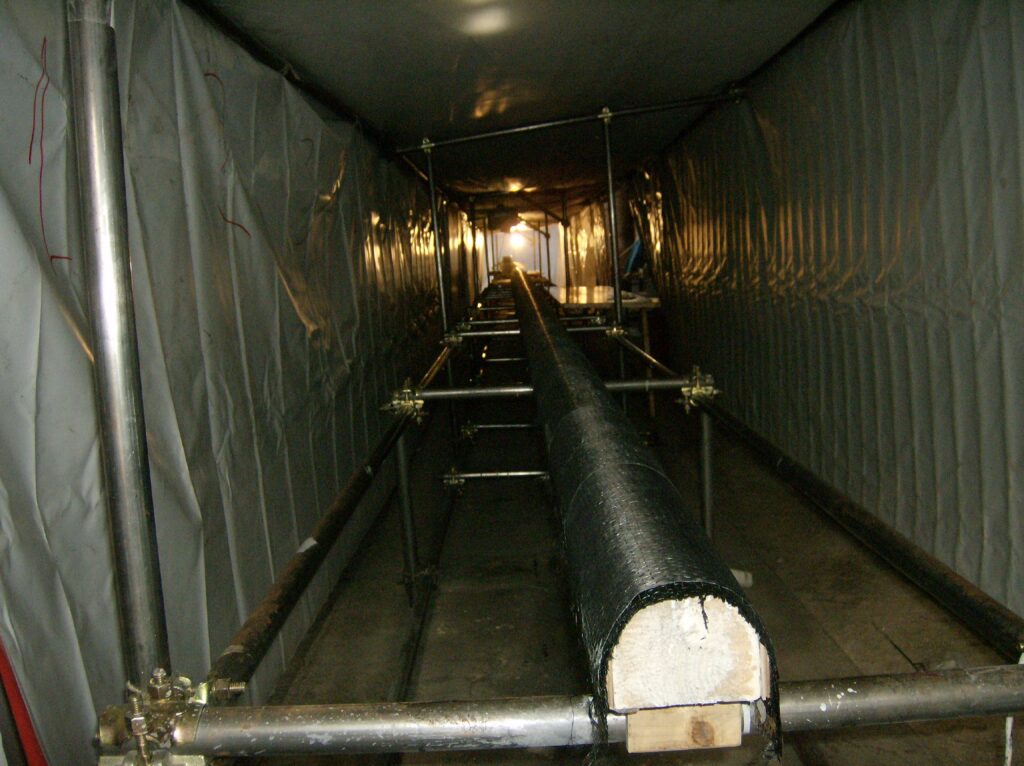
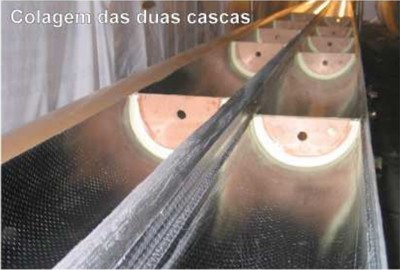
Mário Figueiredo fabricated the mandrel moulds and spars following our custom designed ‘robust’ production processes, which also allowed the same moulds to be used for both main and mizzen yards. The spars were vacuum laminated in two halves which were then bonded together and post-cured in a heated tent.
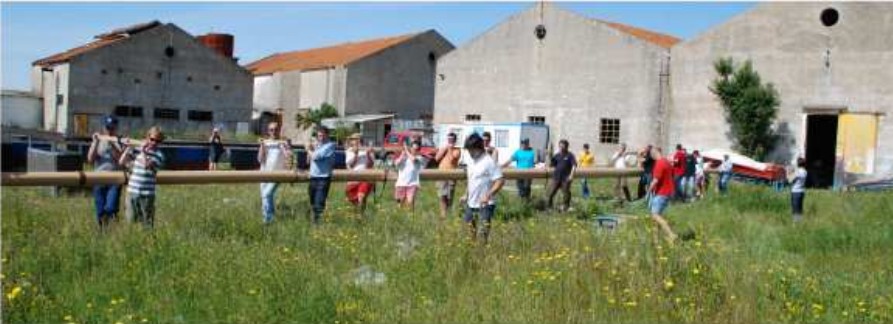
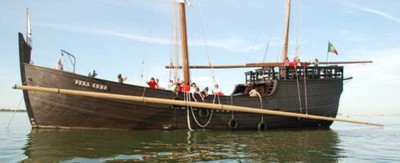
The crew of the Vera Cruz decided on an Atlantic crossing to Madeira as a first ‘sea trial’ which was a little worrying at the time (!), but was a great success; in the words of the skipper, ‘we sailed over 800 nautical miles with fair winds (around 35 knots!) and the spars always performed well’.
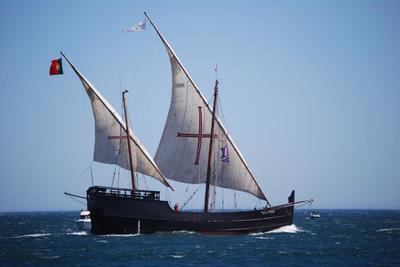
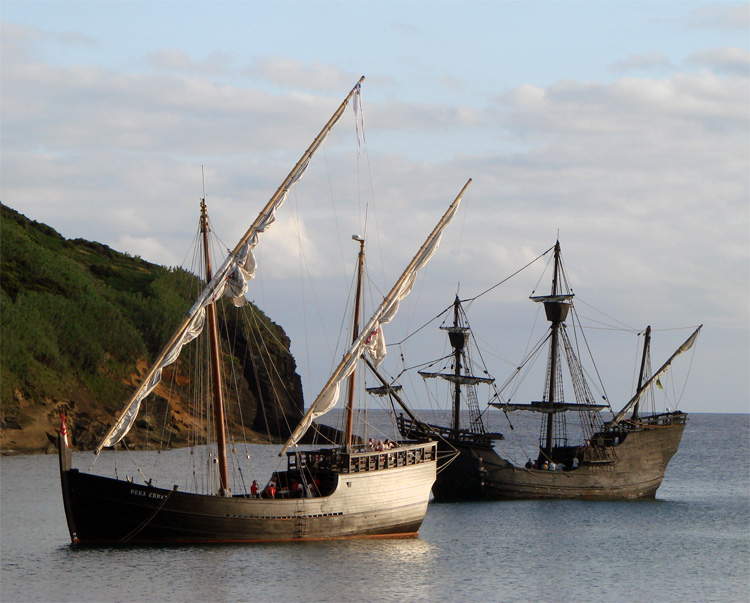
The feedback from consequent regular voyages in and around Lisbon is that the spars are both extremely light and so easy to haul up and down, and that they perform excellently under sail.
‘Muleta’ Traditional Sail Fishing Boat Spars 2023/24

A project to design and fabricate a new lateen mainsail yard for the ‘Velho Álvaro’ – the only Portuguese ‘Muleta‘ sail fishing boat in the world!
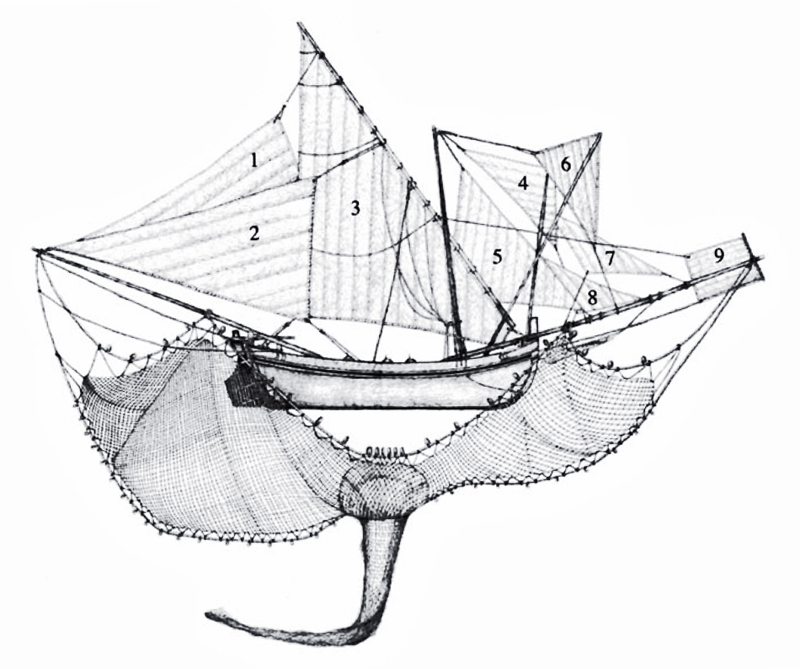
The ‘Muleta’ was a traditional fishing boat from the Tagus (Lisbon River, the Tejo) estuary, emblematic of the towns of Seixal and Barreiro and readily identifiable by its unique ‘cloud of sails’ and characteristically rounded bow.
The fishing method used by the Muletas was a form of pelagic (midwater) trawling performed with the boat ‘hove to’ and drifting slowly abeam to leeward with the net extending to windward and pulled through the water via lines from both sides to the ends of the bowsprit and bumpkin.
This fishing method explains the spectacular array of small sails extended fore and aft of the boat – they allow fine-tuning of the fore and aft position of the sail plan’s centre of effort whilst fishing, thus enabling control of the vessel’s sideways movement through the water. However, when sailing to and from the river mouth fishing grounds only the triangular lateen rigged mainsail was set. The main yard supporting this mainsail is the subject of this work.
Sadly, by 1901 there was only one working Muleta, and by 1928 no vessels at all using this fishing method were left. However, in 2018 Jaime Ferreira da Costa & Irmão, Lda Construções e Reparações Navais constructed a replica Muleta – the ‘Velho Álvaro’ – for the City of Barreiro.
Work up till now has modelled the original wooden spar of the ‘Velho Álvaro’ and designed a new composite material replacement using the same simple bending analytical model to evaluate the yard strength and stiffness as used for the caravel ‘Vera Cruz’, details of which may be found in Viegas S, Sutherland LS, Miller PH, 2024. Initial structural analysis of a Portuguese ‘Muleta’ lateen mainsail yard. Advances in Maritime Technology and Engineering Volume 1, Taylor and Francis, London.
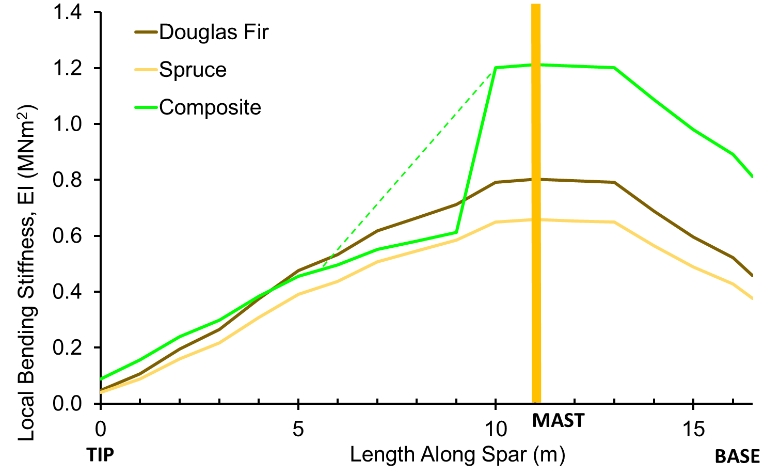
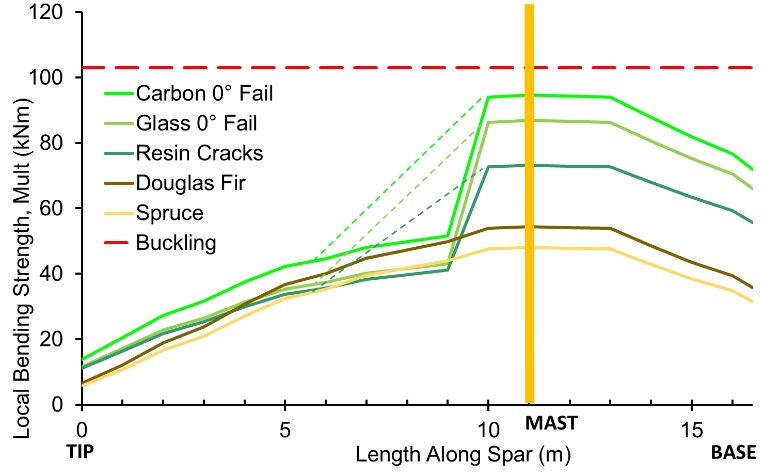
Also in this paper, a Finite Element Analysis (FEA) of the wooden yard enabled estimation of its deflection under load.
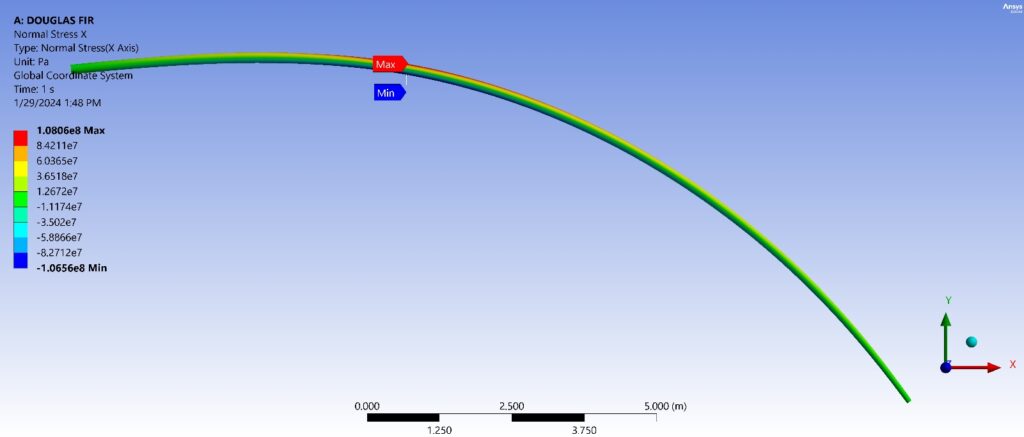
An FEA model of the composite yard as designed by the bending-only analytical model was then completed. As suspected, the off-axis fibres were seen to be adding considerable shear stiffness which was not previously included in the previous analytical model. This showed that the initial composite yard design was over-stiff and could be refined, thus reducing materials, cost and weight.
This next stage of the design process will be presented at MARSTRUCT 2025: Analysis and Design of Marine Structures, 10th International Conference on Marine Structures, 19 – 23 May 2025, Lisbon, Portugal.